Research area 01

CFD + AI

Computational flow, accelerated by physics-aware AI.

We explore how machine learning can complement computational fluid dynamics—from faster parameter studies to turbulence modelling, inverse design, and flow control—while preserving the physical constraints that make engineering predictions trustworthy.
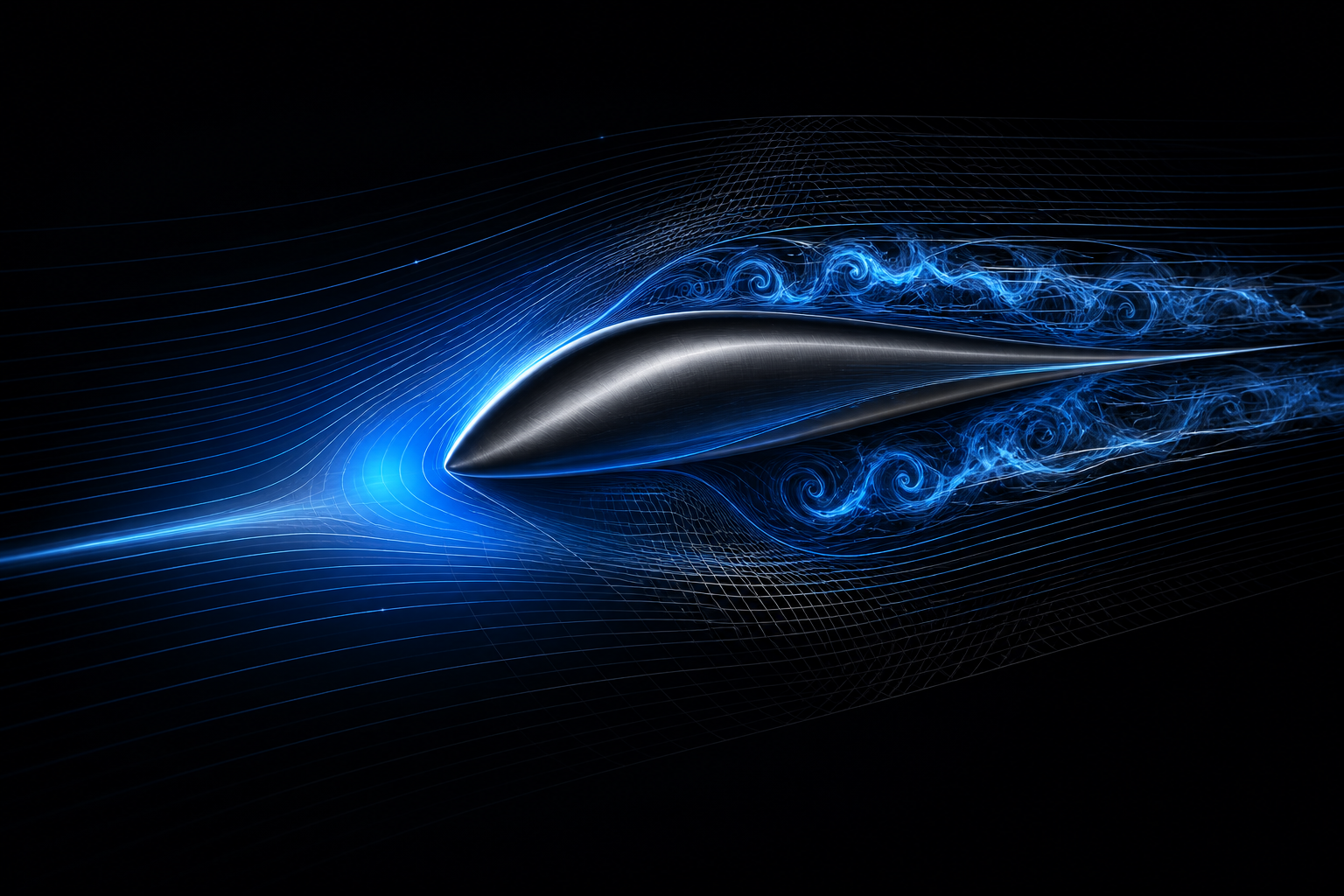
Conceptual visualization of streamlines and vortices around an aerodynamic body
Conceptual visualization · not simulation output

Data landscape

What a trustworthy model must understand.

CFD resolves conservation equations for mass, momentum, and energy. AI can reduce cost or reveal structure, but it does not remove the need for numerical and experimental validation.

Inputs

Geometry & conditions

Geometry, mesh, initial and boundary conditions, material properties, and operating regime.

Fields

Flow state

Velocity, pressure, temperature, species concentration, turbulence quantities, and convergence history.

Outputs

Engineering quantities

Lift and drag, pressure loss, heat-transfer coefficient, Nusselt number, mixing, and forces.

Validation

Physical reliability

Conservation residuals, long-horizon stability, uncertainty, and performance on unseen geometries and regimes.

Key descriptors

From regime to performance.

Re
Reynolds numberBalances inertial and viscous effects.
Ma
Mach numberRelates flow speed to the speed of sound.
Pr
Prandtl numberCompares momentum and thermal diffusivity.
CD / CL
Force coefficientsNormalize drag and lift across operating conditions.
Nu
Nusselt numberExpresses convective heat-transfer enhancement.
ε
Prediction errorReported with conservation, stability, cost, and uncertainty—not alone.

Potential directions

Where AI can contribute.

  • Physics-aware surrogatesRapid design-space exploration with governing constraints embedded in training or architecture.
  • Data-assisted closuresRANS and LES corrections evaluated through full simulation rollouts, not only pointwise fit.
  • Inverse designOptimization of shapes and operating conditions under physical and manufacturing constraints.
  • Flow reconstructionInference of full fields from sparse sensors with calibrated uncertainty.

Selected literature

Research context.

  1. Machine Learning for Fluid MechanicsAnnual Review of Fluid Mechanics, 2020
  2. Enhancing computational fluid dynamics with machine learningNature Computational Science, 2022
  3. Physics-informed machine learningNature Reviews Physics, 2021
  4. Learned turbulence modelling with differentiable fluid solversJournal of Fluid Mechanics, 2022